Most of us like making plans because plans give us a sense of certainty.
We decide what we want, figure out how we’re going to get there, and imagine that if we execute correctly, reality will cooperate.
Then reality gets involved.
The business idea you were certain people would love doesn’t sell.
The investment thesis you carefully researched turns out to be wrong.
The productivity system that looked perfect on paper becomes annoying after two weeks.
The content you spent days creating gets ignored, while something you made in an hour unexpectedly takes off.
This can feel like failure, especially when you’ve invested a lot of time into the original plan.
I think there’s a better way to look at it.
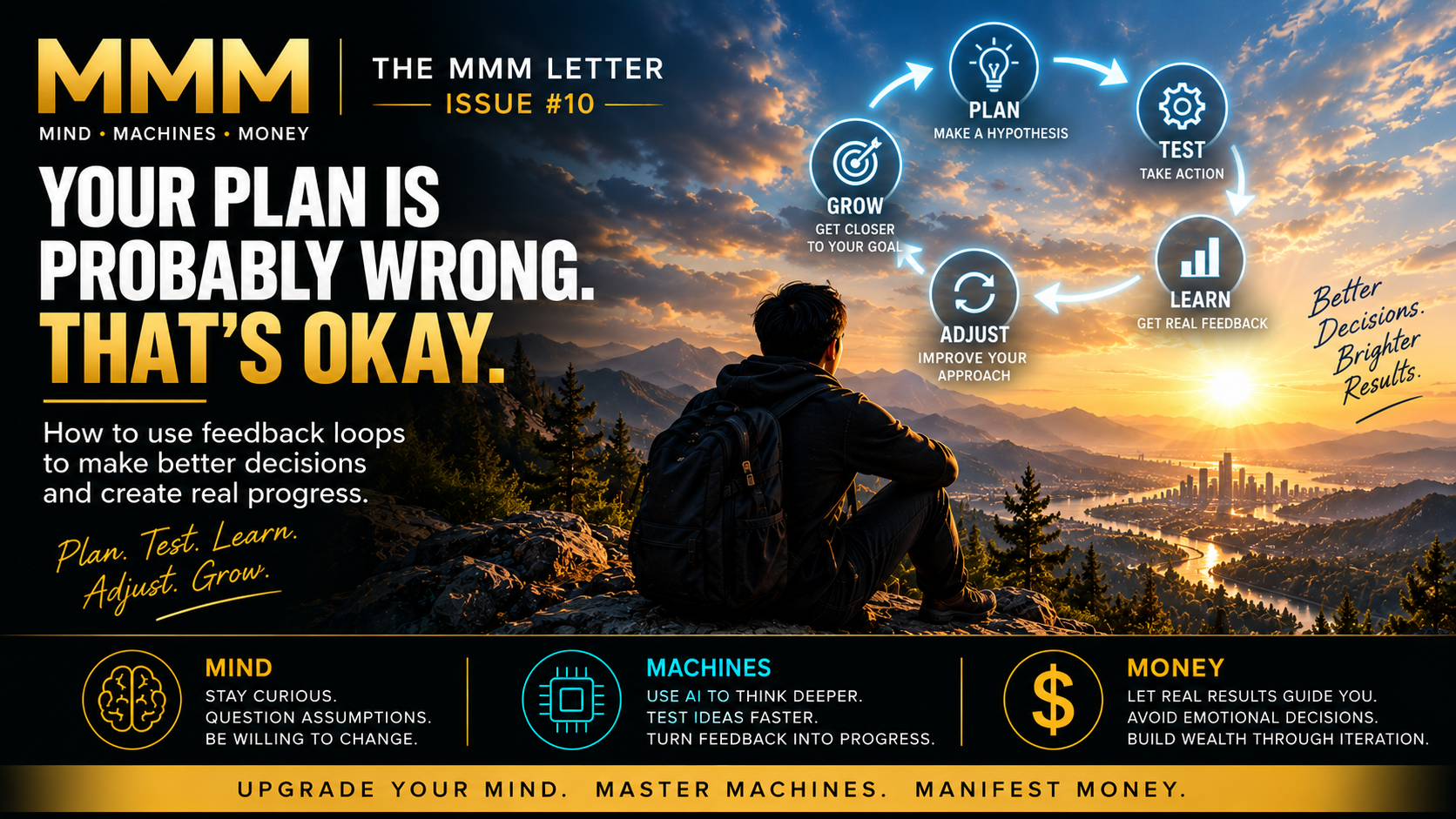
Your first plan isn’t supposed to be perfect. It’s supposed to give you something to test.
You make your best decision with the information available to you, take action, observe what happens, and use the results to make a better decision.
Then you repeat the process.
That’s a feedback loop.
The goal isn’t to predict the future perfectly.
It’s to become better at adapting to it.
Stop Protecting Your Old Decisions
One of the hardest things about changing direction is admitting that something we believed might have been wrong.
We become attached to our ideas.
Once we’ve publicly committed to something, spent money on it, or invested months of our lives into it, walking away can feel like admitting defeat.
So we defend the original decision.
We search for evidence that supports it and ignore evidence that doesn’t. We tell ourselves that we simply need to work harder.
Sometimes persistence is exactly what’s needed.
Other times, we’re protecting our ego instead of pursuing the outcome.
There’s an important distinction between being committed to your goal and being committed to your method.
Suppose you want to become financially independent.
That’s the goal.
The business you’re currently building is one possible method.
If the business consistently gives you evidence that the model doesn’t work, abandoning or changing it doesn’t necessarily mean you’ve abandoned financial independence.
You’ve changed the vehicle.
The same principle applies almost everywhere.
You can remain committed to becoming healthier while changing your exercise routine.
You can remain committed to building an audience while changing your content strategy.
You can remain committed to learning while realizing that the course you purchased isn’t very good.
A strong identity doesn’t require you to defend every decision you’ve ever made.
It gives you enough confidence to say:
“That didn’t work. What did it teach me?”
Use AI as a Thinking Partner, Not an Answer Machine
One of the easiest mistakes to make with AI is treating it like an oracle.
You ask what business you should start, what stock you should buy, what career you should pursue, or what strategy you should follow.
The answer sounds intelligent, so you assume it must be correct.
That’s not the most effective way to use these tools.
Instead of asking AI to make your decisions, use it to improve the quality of your thinking around those decisions.
For example, after developing a business idea, you could ask AI to challenge your assumptions.
What would need to be true for this idea to work?
What am I assuming about the customer?
What are the strongest reasons this could fail?
What evidence would change my mind?
What could I test before investing significant time or money?
You can also give AI the results of an experiment and ask it to help identify patterns you may have overlooked.
This turns AI from an answer generator into something closer to an intellectual sparring partner.
There is still an important limitation: AI can reason from the information you give it, but it doesn’t replace reality.
Customers clicking “buy” is information.
People watching your content is information.
A strategy performing under real market conditions is information.
Your actual behavior is information.
AI can help interpret the feedback.
It cannot manufacture the feedback for you.
You still have to do something in the real world.
The Market Doesn’t Care About Your Thesis
Markets provide unusually honest feedback.
You can spend weeks researching an investment and develop an incredibly sophisticated argument for why it should increase in value.
The market is under no obligation to agree with you.
This doesn’t mean every price movement proves your analysis right or wrong. Markets are noisy, and good decisions can produce bad short-term outcomes just as poor decisions can occasionally produce good ones.
The larger lesson is about humility.
Whenever money is involved, it’s easy to become emotionally attached to being right.
A trader holds a losing position because selling would mean admitting the trade didn’t work.
An entrepreneur continues funding a product nobody wants because they’ve already invested too much into building it.
An investor refuses to reconsider an assumption because the original thesis has become part of their identity.
The cost of being wrong isn’t necessarily the biggest danger.
The bigger danger is being wrong and refusing to update.
Good decision-making requires separating the quality of the process from the outcome of any single decision.
Ask whether your original reasoning made sense based on what you knew at the time.
Then ask whether the information has changed.
If it has, your thinking should be allowed to change too.
Changing your mind when the evidence changes isn’t weakness.
It’s learning.
Action Steps You Can Take Today
Choose one area of your life where you’re currently trying to make progress.
It could be your career, business, finances, health, content, relationships, or a skill you’re developing.
Write down what you currently believe about it.
For example:
“I think doing X will produce Y.”
Then decide what evidence you would expect to see if that assumption is correct.
Give yourself a reasonable period to test it.
Once you have enough information, review the results without trying to defend your original idea.
Ask yourself what worked, what didn’t, what surprised you, and what you would do differently if you were starting again today.
Then make one adjustment.
You don’t need to reinvent your entire strategy every time something goes wrong. Small corrections made repeatedly can dramatically change where you eventually end up.
Think about steering a ship across an ocean.
The destination might remain the same for the entire journey, even though the ship makes countless small course corrections along the way.
Your life works similarly. You choose a direction, make a move, observe, and adjust.
Rinse and repeat.
Don’t demand that your first plan be right. Build a process that gets you closer to right over time.
Thanks for reading. I’ll see you next Friday.
— Phil Zen Kim
Founder of MMM
P.S. Think of something you were completely convinced about five years ago that you no longer believe today. Changing your mind isn’t always evidence that you were foolish before. Sometimes it’s evidence that you learned something.