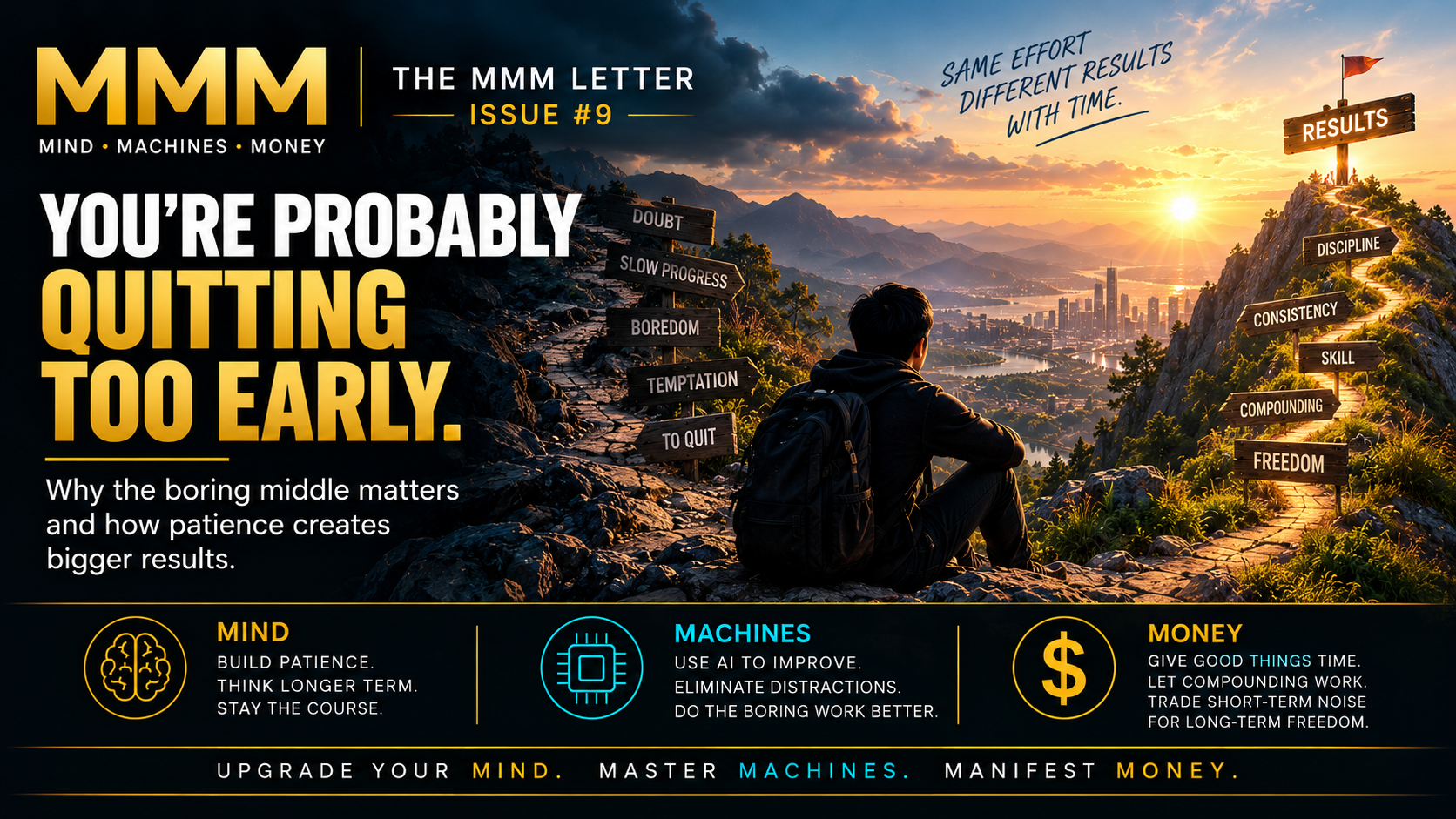
There’s an uncomfortable period that comes with almost every worthwhile pursuit.
You’ve started putting in the work and you’re trying to improve, yet nothing seems to be happening.
The business isn’t making much money. The audience isn’t growing. Your investments don’t feel significant yet. The new skill still feels awkward, and the habit you committed to hasn’t transformed your life.
You look at the effort going in and compare it with the results coming out, and the equation doesn’t seem fair.
That’s usually when doubt starts creeping in.
Maybe I chose the wrong thing. Maybe this isn’t working. Maybe there’s a better opportunity somewhere else.
Sometimes those thoughts are correct. There are bad strategies, bad investments, bad businesses, and projects that deserve to be abandoned.
Other times, the strategy isn’t the problem.
You simply haven’t given it enough time.
We tend to imagine progress as a straight line where one unit of effort produces one unit of results. Real life rarely works that neatly.
There are often long stretches where you’re accumulating things that aren’t immediately visible: knowledge, skill, trust, relationships, capital, an audience, and experience.
Eventually, those things can begin interacting with one another. What looked like very little progress can gradually turn into momentum.
The difficult part is surviving the period before that happens.
Learn to Tolerate the Boring Middle
Starting something is exciting because you have a new goal, a new plan, and a picture in your head of what life might look like if everything works.
Finishing can be exciting too because you can finally see the result.
Everything in between is where things get difficult.
I call this the boring middle.
It’s the hundredth workout when the excitement of starting has disappeared. It’s publishing when hardly anyone is reading. It’s practicing a skill while still being mediocre at it.
It’s continuing to invest when your portfolio isn’t large enough for the gains to feel meaningful. It’s working on a business after you’ve discovered that entrepreneurship involves considerably more repetitive work than the highlight reels suggested.
Nothing feels new anymore, while the reward still seems far away.
This is where consistency becomes more important than motivation.
The people who eventually become good at something aren’t necessarily the people who were most excited when they started. They’re often the people who learned how to continue after the excitement disappeared.
When you’re tempted to quit, ask yourself:
“Has this actually failed, or have I simply reached the boring part?”
Boredom by itself isn’t evidence that you’re on the wrong path.
Modern Technology Has Made Patience Harder
Today we have powerful computers that fit neatly in the palm of our hands. With the tap of a few buttons you can order a variety of items, and have it delivered right to your door within a matter of hours.
AI has dramatically shortened the time between wanting something and getting a result.
You can generate an image in seconds, create a first draft almost instantly, summarize a long document in minutes, or prototype an idea in an afternoon that might once have taken weeks.
These capabilities are incredibly useful, although I think there’s a psychological side effect worth paying attention to.
When technology makes immediate results feel normal, slow progress starts feeling like failure.
Some things simply cannot be accelerated at the same rate.
AI can help you write an article quickly, but building an audience that trusts your work still takes time. It can help you develop a business, while good judgment about what customers actually want usually develops through experience.
You can absorb information faster, yet mastery still requires practice. You can automate parts of your work, while years of reputation and credibility can’t simply be generated overnight.
AI can compress the time required to perform many tasks. It cannot eliminate every waiting period between effort and outcome.
Learning which things should be accelerated and which things need time may become an increasingly important skill.
Use machines to move faster where speed actually helps, while remembering that not everything valuable needs to happen immediately.
Wealth Often Looks Boring Before It Looks Impressive
Building wealth provides one of the clearest examples of delayed gratification.
Most people want instant gratification. So rather than invest their money wisely, many people opt for the immediate satisfaction of purchasing expensive shoes, luxury bags, designer sunglasses, and the newest car.
The actual way to get wealthy is the boring route of living below your means, and investing whatever you can over a long period of time.
In the beginning, the portfolio may barely seem to move. Much of the growth may come from the person’s own contributions rather than investment returns, which can make the process feel painfully slow.
As the amount of invested capital grows, however, the potential dollar impact of percentage gains becomes larger.
The same percentage return on $10,000 and $1 million produces very different dollar amounts.
This is one reason the early stages of wealth building can feel so unrewarding. You’re doing much of the work while receiving relatively little visible benefit from compounding.
That can create a powerful temptation to search for shortcuts.
You might take more risk, jump into whatever is currently making headlines, or search for the investment that will finally make things happen faster.
Sometimes that desire for speed destroys the very process that could have worked if given enough time.
The principle extends beyond investing.
Businesses need time to develop customers. Skills need time to become valuable. Content libraries need time to accumulate. Reputations need time to spread, and assets often need time to mature.
None of this means that waiting guarantees success. Time cannot turn a bad asset or flawed strategy into a good one.
When you’ve chosen something sound, however, patience gives it room to work.
Action Steps You Can Take Today
Think about one meaningful goal you’re currently pursuing and ask yourself what would genuinely cause you to stop.
What evidence would tell you that the strategy isn’t working?
Try to define that before you’re frustrated.
If you’re building a business, you might decide to test a particular strategy for six months before evaluating it.
If you’re learning a skill, you could commit to a certain number of practice hours before deciding whether the skill deserves more of your time.
If you’re creating content, you might commit to a consistent publishing schedule for a meaningful period before judging the entire project solely by audience size.
The exact timeframe depends on what you’re doing. The important part is separating evaluation from emotion.
Create checkpoints where you deliberately review the evidence.
Ask what’s improving, what’s stagnant, what you’ve learned, whether your original reasoning still makes sense, and what needs to change.
Then make a decision.
You might continue exactly as planned. You might adjust the strategy. You might discover that walking away really is the right choice.
This approach gives you permission to quit when quitting is rational without allowing every difficult week to become another reason to start over.
Sometimes changing direction is exactly what you need. Other times, you’re standing in the uncomfortable period between beginning something and becoming good enough for the results to show.
If you continually abandon worthwhile things before they’ve had enough time to develop, you’ll spend your life experiencing beginnings without ever discovering what comes after them.
Choose carefully, adjust intelligently, and give worthwhile things enough time to work.
Thanks for reading. I’ll see you next Friday.
— Phil Zen Kim
Founder of MMM
P.S. If you know someone who’s thinking about abandoning something because progress feels slow, send them this issue. It might help them decide whether they’ve reached a dead end or simply entered the boring middle.