There are days when you feel unstoppable.
You wake up motivated. You have an entire plan mapped out. You start to exercise and work on your goals. You are eating better and making some good progress.
And you think:
“This time, I’m finally going to stay consistent.”
Then Tuesday happens.
You’re tired.
Something goes wrong.
You don’t feel like doing the work.
Suddenly, the habits that seemed easy yesterday require enormous effort.
This is where most plans begin to fall apart.
It’s not because the goal was wrong.
It’s not because you aren’t capable.
It’s because the plan depended on something incredibly unreliable.
It depended on whether you felt like doing it.
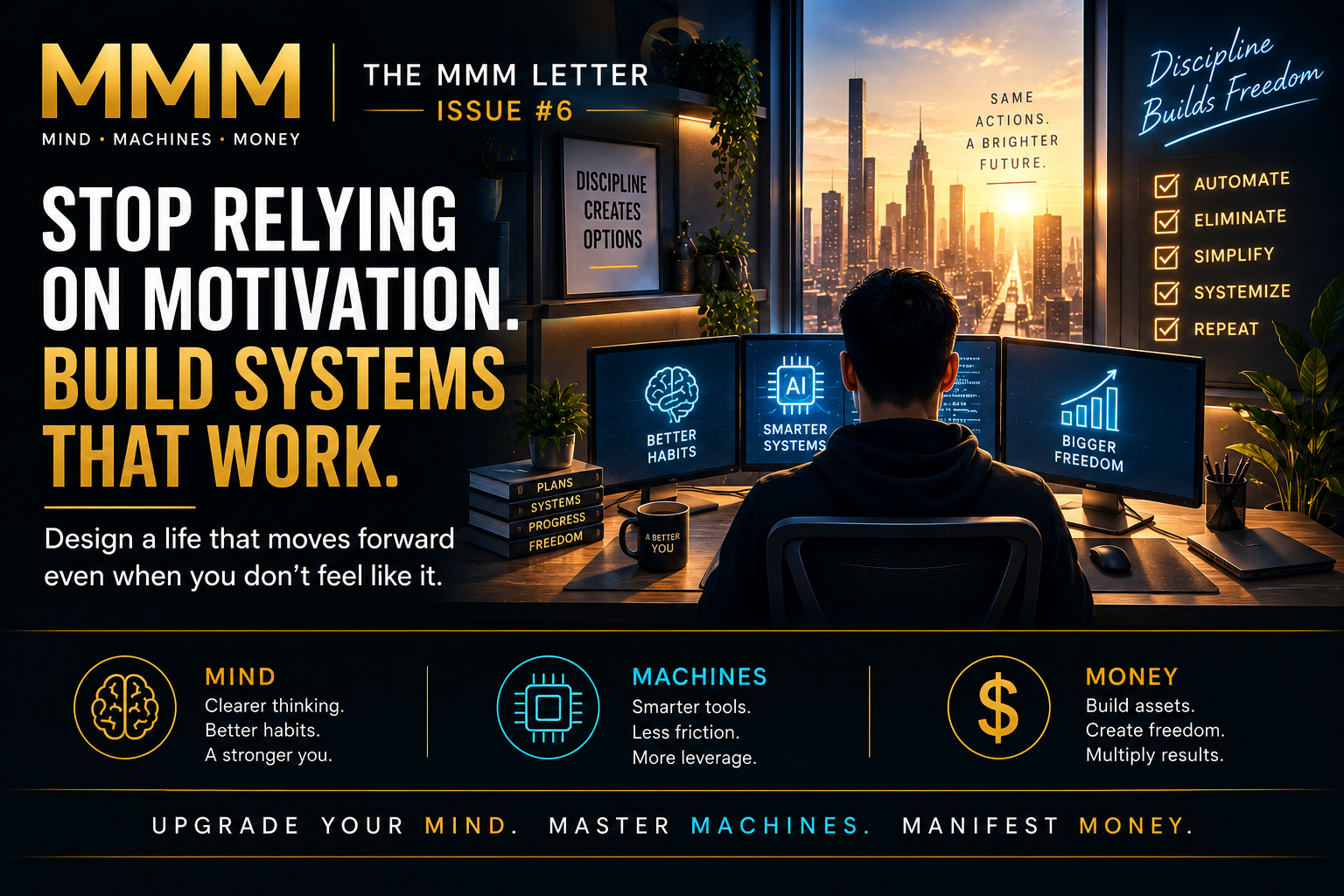
Motivation is useful for getting started, but it’s terrible infrastructure for building a life.
The alternative is to build systems that make progress easier even when motivation disappears.
Your Environment Is Shaping You
We like to imagine that our behavior comes entirely from willpower.
Take a look around you. Your phone is within reach.
Notifications are waiting.
Netflix remembers exactly where you stopped.
Social media has an infinite feed ready whenever you become slightly bored.
Food can arrive at your door with a few taps.
Modern life is filled with systems designed to make certain behaviors incredibly easy.
So instead of constantly fighting your environment, change the environment.
Want to read more?
Put the book somewhere you’ll see it.
Want to stop checking your phone while working?
Put it in another room.
Want to exercise in the morning?
Prepare everything the night before.
Want to create consistently?
Choose a recurring time and place where creation happens.
This seems almost too simple, and that’s the point.
Good systems reduce the number of decisions required to do the right thing.
You don’t want to win the same argument with yourself every morning.
Design the argument out of the equation.
Use Machines to Remove Friction
This is where technology becomes extremely powerful.
Most people use technology to consume.
You can also use it to design your environment.
Calendar recurring tasks.
Automate repetitive work.
Create templates.
Use AI to handle first drafts.
Build reusable prompts.
Schedule reminders.
Create workflows that move information automatically.
The goal isn’t to automate your entire life.
It’s to stop repeatedly spending your attention on things that don’t require your creativity or judgment.
Imagine something takes you 20 minutes every week.
That’s not much.
However, if you build a system that reduces it to two minutes, you’ve reclaimed more than 15 hours over the next year.
Now imagine doing that across ten recurring tasks. That’s leverage.
The question I’d ask this week is:
“What am I doing manually simply because I’ve never stopped to build a better system?”
Every recurring frustration is a potential candidate for automation.
Your Financial Life Shouldn’t Depend on Willpower Either
The same principle applies to money.
Imagine deciding every month whether you’re going to save.
Some months you will.
Other months something will come up.
Eventually, saving becomes whatever is left over.
Now compare that with a system where money automatically moves toward your goals.
Income arrives.
A portion goes toward expenses.
A portion goes toward savings.
A portion goes toward long-term investments.
A portion can go toward building or acquiring assets.
You still decide the strategy.
Once you’ve decided, the system helps execute it consistently.
This is one of the most powerful principles in personal finance:
Make the behavior you want happen by default.
The same idea applies to building income.
Instead of constantly asking:
“How can I make money today?”
You can gradually build systems and assets capable of producing value repeatedly.
A business system.
An investment portfolio.
Evergreen content.
Software.
Intellectual property.
A newsletter.
The objective isn’t necessarily “passive income.”
Very little is truly passive.
The objective is something more realistic:
Separating some portion of your future results from your future hours.
I use an app called Rocket money. It’s connected to my bank accounts and my credit cards. It tracks all my spending every month, and lets me categorize each expense into the proper categories. This allows me to track my spending and see where I am overspending each month. Seeing this visual data also makes it way easier to stick to a monthly budget. This is one example of using an automated system that doesn’t depend on willpower and whether you feel like doing something.
Action Steps You Can Take Today
Find one recurring problem in your life.
Something you repeatedly procrastinate on.
Or waste time doing manually.
Then don’t ask:
“How can I become more disciplined?”
Ask:
“How could I redesign this so it requires less discipline?”
Maybe you automate it.
Schedule it.
Remove a distraction.
Create a template.
Change your environment.
Use AI.
Eliminate the task entirely.
Establish a simple rule so you don’t have to keep making the same decision.
Start with one.
Then improve another.
And another.
Over time, something interesting begins to happen.
Your environment starts working with you instead of against you.
You still need discipline.
You still need ambition.
You still need to act.
You no longer need to manufacture motivation every morning just to keep moving.
The goal isn’t to become someone who is motivated all the time.
It’s to build a life that still moves forward when you’re not.
Thanks for reading. I’ll see you next Friday.
— Phil Zen Kim
Founder of MMM
P.S. If you know someone constantly waiting to “feel motivated again,” forward this issue to them.