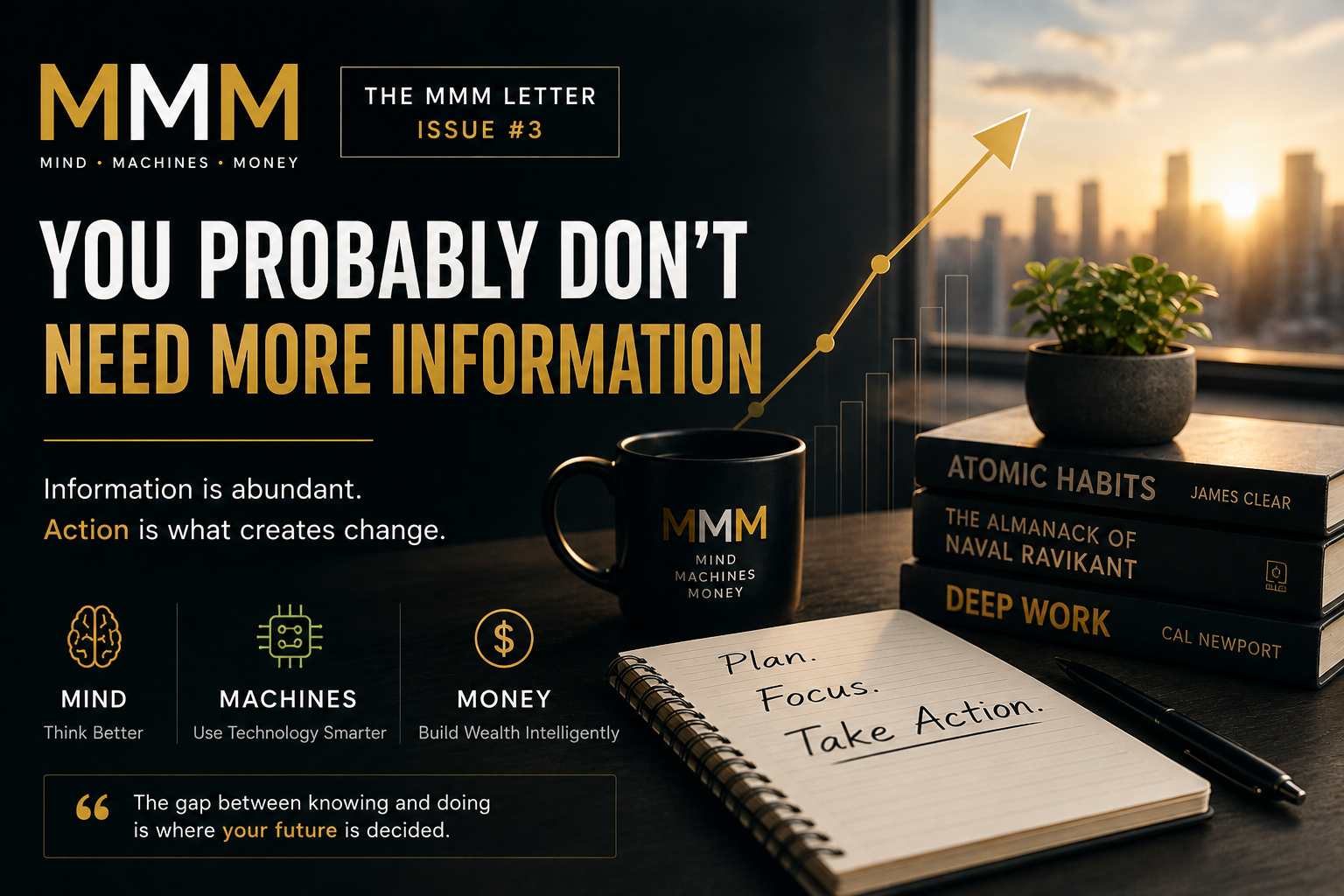
We live in an age where almost anything you want to learn is available within seconds.
Want to start a business? There are thousands of tutorials.
Want to learn how to invest? Entire university courses are available for free.
Want to use AI? You can find hundreds of tools, prompts, and guides before finishing your morning coffee.
Want to improve your life? There’s an endless supply of books, podcasts, videos, and newsletters telling you how.
And yet, having access to more knowledge doesn’t necessarily mean we’re making more progress.
Sometimes, learning becomes a sophisticated form of procrastination.
We tell ourselves:
“I’ll start once I understand this better.”
So we watch another video.
Read another article.
Save another post.
Ask AI another question.
Eventually, we know far more than we need to know, but haven’t actually done much with it.
There’s a point where the next piece of information has less value than simply acting on what you already know.
Knowledge Isn’t Power Until It’s Applied
Imagine someone who has read 20 books about investing but has never invested a dollar.
Now imagine someone who has read one good book, understands the fundamentals, and has consistently invested for ten years.
Who benefited more from their knowledge?
The same principle applies almost everywhere.
You can study entrepreneurship without starting a business.
You can consume productivity content while procrastinating.
You can research fitness while avoiding exercise.
You can learn about meditation without ever sitting quietly for ten minutes.
Information creates potential.
Action converts that potential into experience.
And experience gives you something information can’t:
feedback.
Once you act, reality starts teaching you.
You discover what works.
You discover what doesn’t.
You discover what you misunderstood.
And suddenly, the next thing you need to learn becomes much clearer.
Instead of asking:
“What else do I need to know?”
Try asking:
“What do I already know that I’m not applying?”
That question can be uncomfortable.
But it can also save you hundreds of hours.
AI Tool Spotlight: Perplexity
AI has made accessing information easier than ever, which makes filtering that information even more important.
Perplexity is particularly useful when you want to research a topic while being able to trace information back to its sources.
Rather than opening dozens of browser tabs, you can use it as a starting point for exploring a question, identifying relevant sources, and deciding where you want to investigate further.
But there’s an important distinction:
AI should help you compress the research process, not give you another excuse to remain in research mode forever.
Use AI to get from question → understanding → action faster.
Not question → infinite questions.
The Most Valuable Form of Wealth Might Be Ownership
Most people are paid for something that disappears almost immediately:
their time.
You work an hour.
You get paid for an hour.
Then the transaction is finished.
There’s nothing inherently wrong with that. Most of us begin there.
But long-term wealth becomes much more interesting when some of your effort starts producing things you can own.
Here are a few examples of assets you can own:
- A business.
- Investments.
- Intellectual property.
- Software.
- A website.
- A newsletter.
- Evergreen content.
- A digital product.
These assets can continue creating value after the initial work has been completed.
That doesn’t make them passive.
It makes them leveraged.
The goal isn’t necessarily to stop working.
It’s to gradually shift more of your work toward things that continue benefiting you after the workday ends.
Ask yourself:
How much of my effort this week created something I still own?
Action Steps You Can Take Today
Pick one thing you’ve been researching but haven’t started.
Don’t research it again today.
Instead, spend 20 minutes doing the smallest real version of it.
If you’ve been learning about investing, review what you actually need to take your first responsible step.
If you’ve been researching a business idea, create the first rough version of the offer.
If you’ve been learning AI, build one useful workflow.
If you’ve been thinking about creating content, publish something.
It doesn’t need to be impressive.
The objective is simply to cross the line between consuming and creating.
Because the internet has made information abundant.
AI is making intelligence increasingly accessible.
But there’s one thing neither can do for you:
take the first step.
Thanks for reading. I’ll see you next Friday.
— Phil Zen Kim
Founder of MMM
P.S. If this issue reminded you of someone who has 47 browser tabs open while researching their next big idea, send it to them. Maybe they’ll finally close a few.