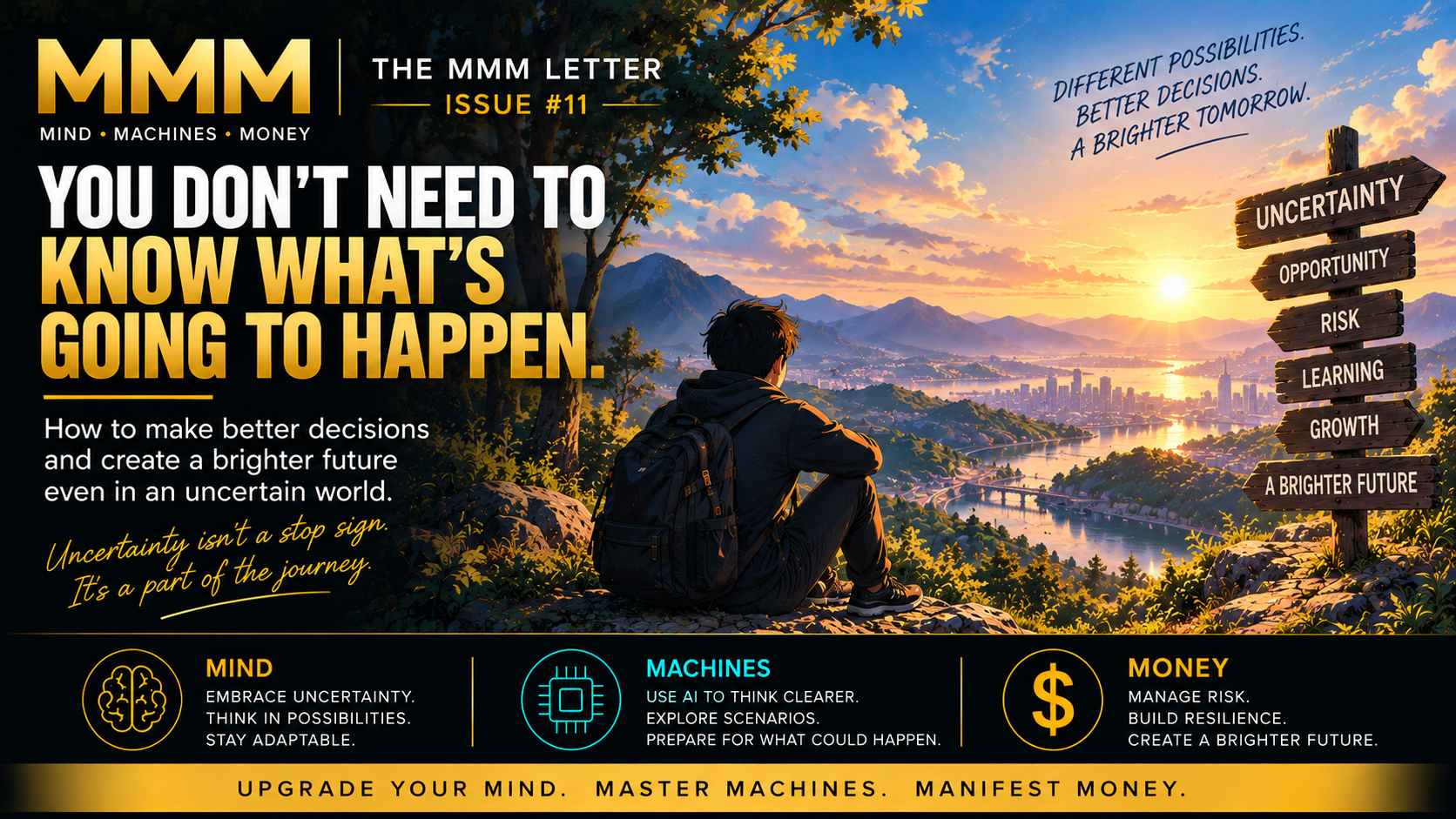
We spend a surprising amount of our lives trying to predict the future.
We want to know whether the investment will go up, whether the business will succeed, whether AI will disrupt our career, whether moving somewhere new will make us happier, or whether the decision we’re about to make will turn out to be the right one.
Knowing the answer would make everything easier.
Unfortunately, life doesn’t give us that luxury.
Most meaningful decisions have to be made with incomplete information.
You can research. You can prepare. You can think carefully about the possibilities. At some point, though, you have to make a decision without knowing exactly what happens next.
This creates a temptation to wait.
We tell ourselves that we’ll act once we’re more certain.
Sometimes gathering more information is sensible. Other times, we’re trying to eliminate uncertainty that simply cannot be eliminated.
The better question may not be:
“How can I know what will happen?”
It may be:
“How can I make good decisions even when I don’t know what will happen?”
Those are two very different skills.
Think in Possibilities, Not Predictions
Imagine you’re considering starting a business.
You could spend months trying to determine whether it will succeed.
You research the market, study competitors, analyze trends, and ask other people what they think.
Eventually, you realize something frustrating: nobody knows.
There are too many variables.
Instead of demanding certainty, you can think in terms of possibilities.
Maybe the business works extremely well.
Maybe it produces modest results.
Maybe nobody wants what you’re selling.
Maybe customers want something slightly different from what you originally planned.
Once you accept that several outcomes are possible, you can design your decisions around them.
You might test the idea with a small amount of money before making a large investment. You could talk to potential customers before building the product. You could keep your existing income while experimenting on the side.
Now you don’t need to correctly predict which future will occur.
You’ve built a strategy that allows you to learn without exposing yourself to unnecessary risk.
This is one of the most useful mental shifts I’ve found:
You don’t always need certainty when you have adaptability.
A flexible plan can sometimes be more valuable than an accurate prediction.
AI Can Predict More, but It Can’t Remove Uncertainty
AI is becoming remarkably good at helping us analyze information.
It can examine large amounts of data, identify patterns, compare scenarios, summarize research, and help us think through possible outcomes.
As these systems improve, it will become increasingly tempting to assume that enough intelligence can eventually make uncertainty disappear.
I don’t think that’s going to happen.
The world contains too many interacting variables, and human behavior adds another layer of unpredictability.
AI might help you understand an industry, but it can’t guarantee that your business will succeed.
It can analyze historical market data, but it can’t tell you with certainty where an asset will trade next year.
It can identify career trends, but it can’t know exactly how your own life will unfold.
This doesn’t make AI less useful.
It tells us how to use it more intelligently.
Instead of asking:
“Tell me what’s going to happen.”
Try asking:
“What are the most plausible outcomes, and how should I prepare for each one?”
You can ask AI to challenge your assumptions, identify risks you haven’t considered, create scenarios, or explore what would happen if your expectations were wrong.
Used this way, AI doesn’t become a crystal ball.
It becomes a tool for thinking more clearly under uncertainty.
That’s much more valuable.
You Don’t Have to Predict the Market to Build Wealth
Financial markets attract predictions because uncertainty makes us uncomfortable.
Every day, someone is explaining where stocks are headed, what the Federal Reserve will do next, which cryptocurrency will explode, or when the next recession will arrive.
Some predictions will inevitably be correct.
The problem is knowing which ones beforehand.
A more durable financial strategy doesn’t necessarily require predicting every major event correctly.
It requires building around the possibility that your predictions will sometimes be wrong.
This is why ideas such as diversification, position sizing, emergency savings, long time horizons, and risk management matter.
They’re not particularly exciting.
They also don’t require you to possess supernatural forecasting abilities.
Consider two investors.
One builds a financial plan that works only if their predictions are correct.
The other assumes that some of their predictions will be wrong and structures their finances so that a mistake doesn’t destroy them.
The second person may appear less confident.
In reality, they’ve built something more resilient.
The same principle applies to entrepreneurship and trading.
You don’t need every decision to work.
You need your failures to be survivable and your successes to have enough room to matter.
That’s a very different way to think about risk.
Instead of asking:
“How do I avoid ever being wrong?”
Ask:
“What happens to me when I am?”
If the answer is “I learn something and continue,” you’ve created a very different game from one where a single mistake takes you out completely.
Action Steps You Can Take Today
Think about one decision you’ve been postponing because you don’t know what will happen.
Instead of trying to make yourself more certain, write down three realistic possibilities.
What happens if things go better than expected?
What happens if they go roughly as expected?
What happens if they go badly?
Then look at the downside.
Can you reduce it?
Could you test the decision on a smaller scale?
Could you spend less money initially?
Could you preserve another option while experimenting?
Could you recover if you’re wrong?
Next, look at the upside.
If the experiment works, can you increase your commitment later?
This creates a very different relationship with uncertainty.
You no longer need to convince yourself that everything will work perfectly before you begin.
You’re creating a situation where you can act, gather information, and adjust without requiring the first decision to be perfect.
There will always be things you cannot predict.
Economies change. Technology changes. Markets change. People change, and sometimes you will change too.
Trying to perfectly predict all of it is exhausting.
Build something more resilient instead.
You don’t need to know exactly what the future holds. You need to become someone capable of adapting when it arrives.
Thanks for reading. I’ll see you next Friday.
— Phil Zen Kim
Founder of MMM
P.S. Think about one thing you’re waiting to feel “certain” about. Ask yourself whether you actually need more information, or whether you’ve already reached the point where the only way to learn more is to act.