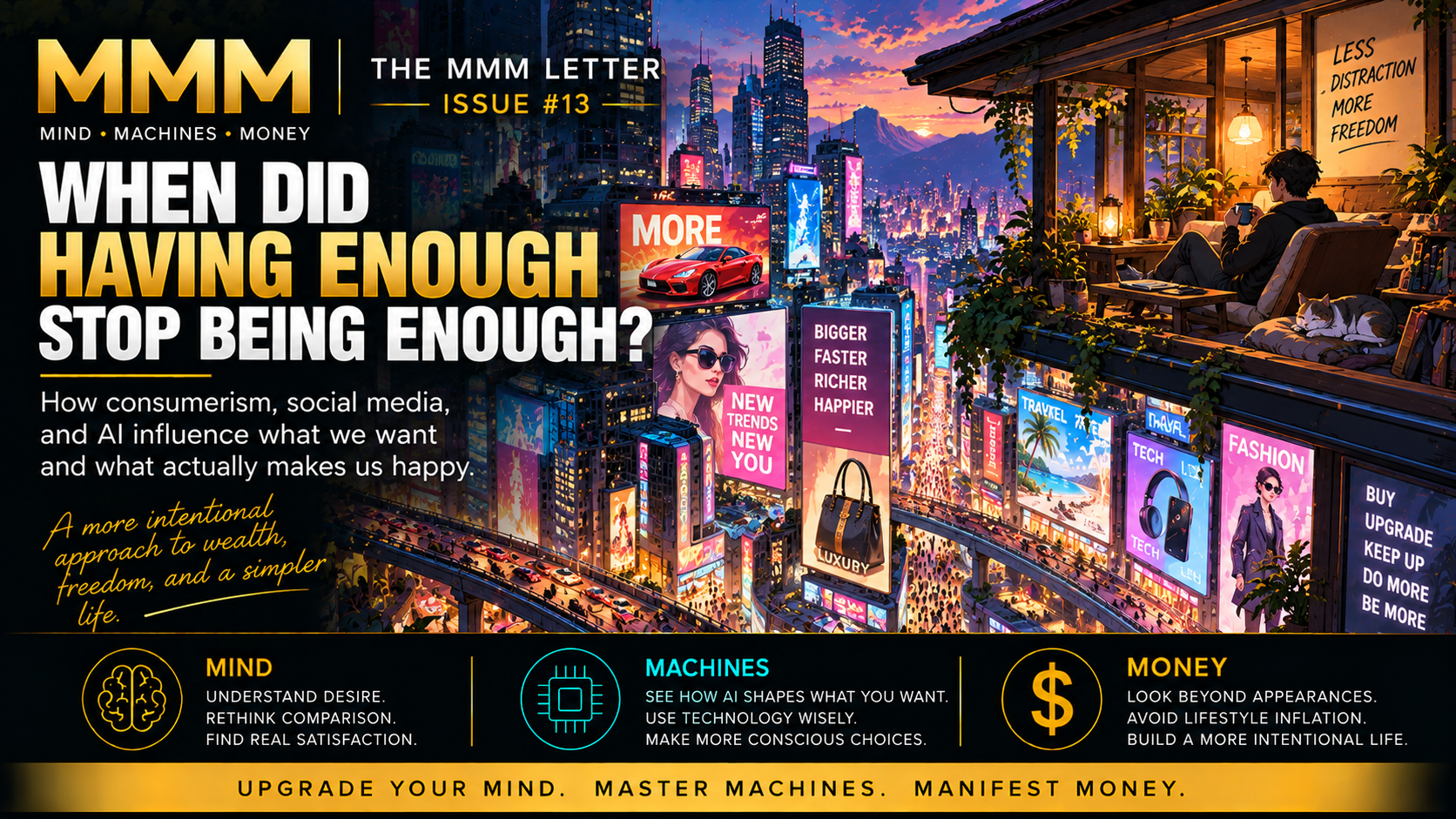
There’s something strange about modern life.
We have access to more products, entertainment, information, and conveniences than almost any generation before us. We can order practically anything from our phones, watch thousands of movies without leaving the house, and use technology that would have seemed impossible just a few decades ago.
Yet somehow, it never seems to be enough.
There’s always a better phone, a nicer car, a bigger house, or another lifestyle to aspire to. Even when we’re perfectly happy with something we already own, seeing what someone else has can suddenly make it feel less satisfying.
Social media has made this particularly noticeable.
Open Instagram or TikTok, and within a few minutes, you might see someone showing off a luxury vacation, an expensive apartment, a successful business, or a shopping haul worth thousands of dollars.
Of course, there’s nothing inherently wrong with enjoying nice things or wanting to improve your circumstances.
The problem begins when our expectations keep rising faster than our ability to feel satisfied.
We start measuring our lives against standards that are constantly changing, often without realizing we’re doing it.
This raises an interesting question: Are we pursuing things because they genuinely improve our lives, or because we’ve been conditioned to believe we should want them?
It’s worth thinking about, especially in a world where entire industries are built around influencing what we desire.
🧠Mind: Why We Always Seem to Want More
Psychologists have a term for our tendency to return to a familiar level of happiness after positive or negative changes: hedonic adaptation.
Imagine buying a new car you’ve wanted for years.
For the first few weeks, everything about it feels exciting. You enjoy driving it, appreciate the interior, and might even find yourself looking back at it after parking.
A few months later, it’s just your car.
You still appreciate it, but the excitement has faded. Eventually, you may start noticing other cars that look more appealing.
The same pattern can happen with a new job, a salary increase, a bigger home, or the latest piece of technology.
We get used to improvements surprisingly quickly.
This isn’t necessarily a flaw in human psychology. Our ability to adapt helps us adjust to changing circumstances. The difficulty comes when we mistake temporary excitement for lasting satisfaction.
There’s another factor involved: comparison.
People have always compared themselves with others, but social media has dramatically expanded the number of people we compare ourselves with.
In the past, your reference points might have been your neighbors, coworkers, friends, and relatives.
Today, you can compare your ordinary Tuesday afternoon with someone else’s carefully edited highlight reel from the other side of the world.
And because social media tends to reward attention-grabbing content, the lifestyles we see aren’t necessarily representative of how most people actually live.
A person earning a comfortable income might feel financially behind after spending an hour watching people display expensive lifestyles online.
Their financial situation hasn’t changed. Only their perception of it has.
Recognizing this doesn’t mean we should stop wanting things or abandon ambition.
It means being more aware of where our desires come from.
Sometimes the things we want are genuinely important to us. Other times, we’re simply responding to what we’ve been repeatedly exposed to.
Learning to tell the difference can save us a surprising amount of money, time, and frustration.
🤖Machines: Technology Is Getting Better at Knowing What We Want
Advertising used to be relatively straightforward.
Companies placed advertisements in newspapers, on television, or along highways and hoped they reached people who might be interested.
Digital advertising changed that by allowing companies to target people based on their interests, behavior, and online activity.
AI is taking this further.
Recommendation systems already play a major role in deciding which videos we watch, which products we discover, and which advertisements appear in front of us.
These systems don’t necessarily understand us the way another person would, but they can identify patterns in our behavior that make their recommendations surprisingly effective.
If you spend time watching videos about home renovations, you may start seeing more interior design content, furniture advertisements, and home improvement products.
Before long, you might find yourself wanting to replace things you hadn’t previously considered replacing.
Technology isn’t necessarily creating a desire from nothing. It’s often identifying an existing interest and reinforcing it through repeated exposure.
Generative AI adds another dimension.
Companies can now create marketing images, videos, and advertisements much faster than before. They can test different messages, personalize content, and produce material designed to appeal to specific audiences.
As these tools improve, the line between genuinely useful recommendations and carefully engineered persuasion may become harder to recognize.
There’s an interesting contradiction here.
The same technology that helps us make better decisions can also make it easier for companies to influence those decisions.
AI can help you compare products, research alternatives, and determine whether something is worth buying. It can also help advertisers become more effective at convincing you to buy things.
The technology itself doesn’t decide which outcome is better for you.
That’s still your responsibility.
One practical habit is to use technology to slow down purchasing decisions rather than speed them up.
Before buying something expensive, ask AI to compare alternatives, identify common complaints, estimate long-term ownership costs, or suggest whether a less expensive option would meet your needs.
Just remember that AI recommendations can contain errors or reflect incomplete information, so important details should still be verified.
A tool that helps you spend more carefully may ultimately be more valuable than one that simply makes shopping more convenient.
💰Money: The Difference Between Looking Wealthy and Being Wealthy
There’s a reason expensive cars, designer clothing, luxury watches, and large houses are commonly associated with success.
They’re visible.
Savings, investments, low debt, and financial security are much harder to see.
You can walk past someone driving a $100,000 car and immediately recognize that they’re driving something expensive.
What you can’t see is whether they own it outright, have a large monthly payment, or are struggling to keep up with the cost.
Likewise, someone driving an older car might have a substantial investment portfolio and very few financial obligations.
Appearances don’t tell us much about a person’s actual financial condition.
This distinction matters because many of the things associated with looking successful can work against the goal of becoming financially independent.
A larger house might come with higher property taxes, insurance, maintenance, and utility bills. An expensive car may require a substantial monthly payment. A lifestyle built around frequent luxury purchases can create ongoing financial obligations that are difficult to reduce.
None of these purchases is automatically irresponsible.
If someone can comfortably afford them and genuinely enjoys them, there’s nothing wrong with spending money that way.
The issue is whether the purchases are improving their quality of life or simply increasing the amount of money they need to maintain their lifestyle.
Consider two people earning the same income.
One spends nearly everything they make on housing, transportation, entertainment, and other expenses. The other lives comfortably but keeps their fixed costs relatively low and invests a meaningful portion of their income.
Both might appear successful, but the second person has more flexibility.
They may be better positioned to handle an unexpected expense, leave an unhealthy job, take time off, or pursue an opportunity that doesn’t provide immediate income.
That’s one of the less glamorous benefits of building wealth.
Money doesn’t just buy things. It can also buy options.
The ability to make decisions without constantly worrying about financial survival is valuable, even if nobody else can see it.
There’s also a point where earning more money stops making much difference if every increase in income is immediately absorbed by higher spending.
This is commonly called lifestyle inflation.
A raise that could have increased savings instead becomes a more expensive apartment. A bonus becomes a new car payment. A growing income creates growing expectations.
It’s easy to fall into this pattern because each individual upgrade can seem reasonable.
The challenge is recognizing when those upgrades are no longer making life meaningfully better.
Financial independence isn’t necessarily about living cheaply or refusing to enjoy your money.
It’s about being deliberate with what you spend so that your financial resources support the life you actually want.
Action Steps You Can Take Today
Think about something you’ve recently wanted to buy.
It doesn’t have to be expensive. It could be a new gadget, a clothing item, a subscription, or an upgrade to something you already own.
Before making the purchase, consider a few questions.
Would I still want this if nobody else knew I owned it?
This can help separate genuine enjoyment from the desire for recognition or status.
What problem will this actually solve?
Sometimes a purchase improves your life in a meaningful way. Other times, the appeal is mostly the excitement of getting something new.
Will I still appreciate this six months from now?
It’s impossible to know for certain, but thinking beyond the initial excitement can help put the purchase into perspective.
You might also try waiting a few days before buying something you hadn’t planned to purchase.
If you still want it after the initial excitement fades, there’s a better chance it’s something you genuinely value.
The goal isn’t to question every dollar you spend or turn personal finance into an exercise in deprivation.
It’s to become more intentional about the things you bring into your life.
After all, there’s little benefit in working hard to earn more money if we constantly feel pressured to spend it on things that don’t make us any happier.
A comfortable life doesn’t necessarily require having everything.
Sometimes it starts with figuring out what enough actually looks like.
Thanks for reading. I’ll see you next Friday.
— Phil Zen Kim Founder & Editor-in-Chief, MMM
P.S. The next time you see someone showing off an expensive lifestyle online, remember that you’re seeing what they’ve chosen to display. You’re not seeing their savings, debts, financial obligations, or the trade-offs behind their purchases.