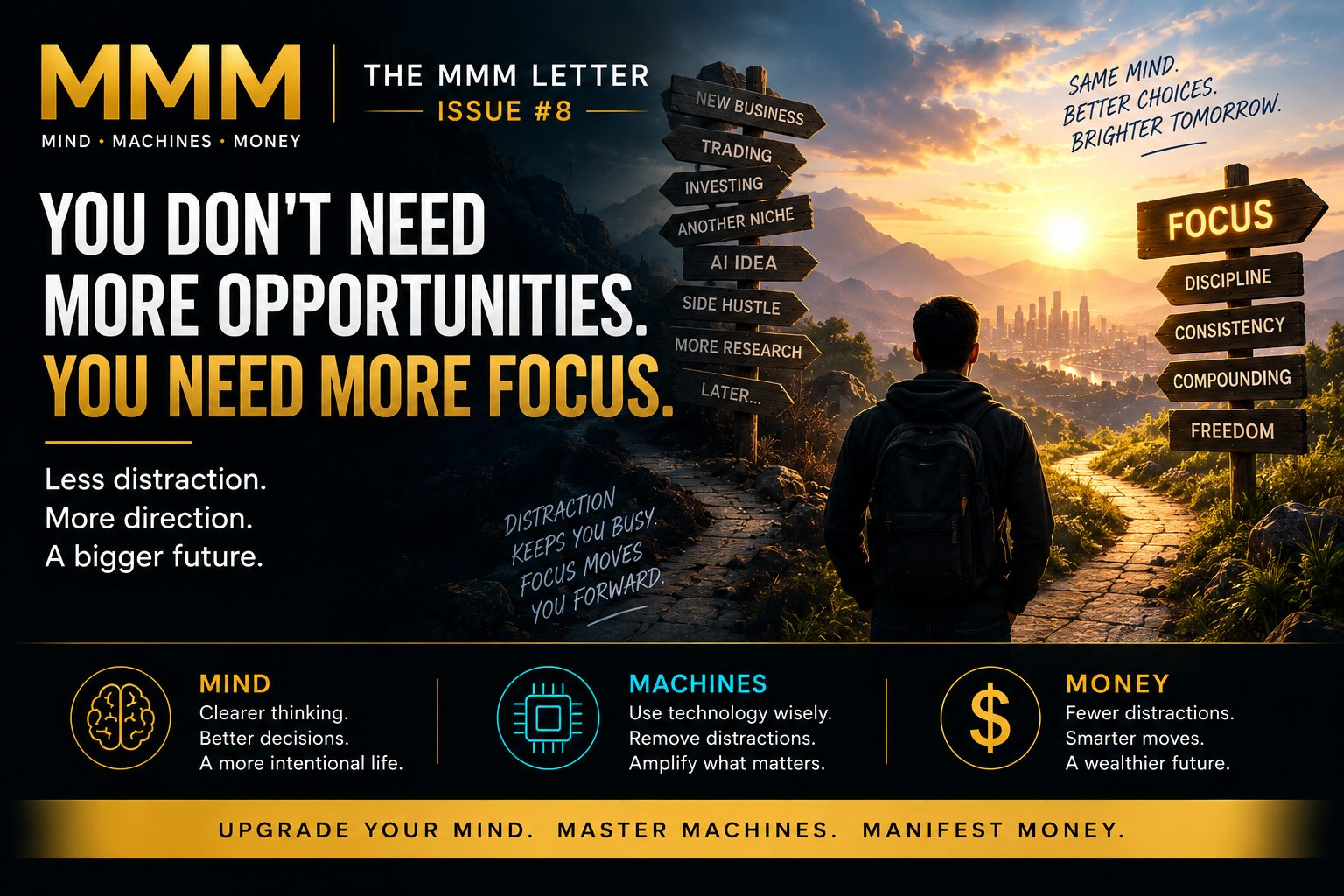
There’s never been a better time to start something.
You can launch a website in an afternoon. AI can help you write, research, code, design, and brainstorm. You can reach people around the world without owning a storefront or buying advertisements.
If you want to start a business, there are thousands of ideas waiting for you.
If you want to make money online, you’ll find even more.
That’s exciting, but it creates a problem we don’t talk about enough.
When opportunities become abundant, choosing what not to pursue becomes increasingly important.
Most ambitious people don’t suffer from a lack of ideas. They have too many of them.
You start learning about investing, then discover trading. You consider starting a business, then hear about a new AI opportunity. You begin creating content, but another niche suddenly looks more promising.
Every path seems like it could work.
So you keep looking.
Eventually, you become very good at starting and very bad at staying.
The internet has given us almost unlimited optionality.
What it hasn’t given us is unlimited attention.
Every Yes Has a Cost
We usually think about decisions in terms of what we gain.
If I start this project, what could happen?
If I learn this skill, what could it lead to?
If I pursue this opportunity, how much could I make?
Those are reasonable questions, but they leave out half of the equation.
Every commitment consumes something.
It requires your time, attention, energy, and often money. More importantly, it prevents those resources from being used somewhere else.
That’s opportunity cost.
The project you’re considering isn’t competing with doing nothing. It’s competing with everything else you could be doing with the same resources.
This becomes especially dangerous when you’re attracted to novelty.
Starting something new feels productive because there’s so much possibility. You can imagine what the business might become, how much money it could make, or how different your life could look.
Then the exciting part ends.
Now you have to do the same boring things repeatedly.
That’s usually when another opportunity starts looking attractive.
The problem may not be that your original idea stopped being good.
You simply reached the part where progress stopped being exciting.
There’s a question I’ve found useful for evaluating new opportunities:
“Is this actually better than what I’m already doing, or is it just newer?”
Those are very different things.
AI Makes Focus More Important, Not Less
AI is removing barriers to creation at an incredible rate.
You can brainstorm fifty business ideas before breakfast. You can generate hundreds of pieces of content. You can prototype software without being an experienced developer. You can research industries you previously knew nothing about.
This dramatically expands what one person can attempt.
But there’s an unintended consequence.
AI can make distraction feel like productivity.
You can spend an entire evening researching businesses you’ll never start, generating strategies you’ll never execute, and building plans you’ll never follow.
At the end of the night, you’ve produced a lot, but you haven’t necessarily moved forward.
This is why I think the scarce resource of the AI era won’t simply be intelligence.
It will be directed attention.
When everyone can generate more ideas, the ability to recognize which ideas deserve sustained effort becomes more valuable.
AI should help you go deeper, not simply give you more directions to run.
Instead of asking it for another ten ideas, try giving it the one you’re already pursuing and ask:
“How can I improve this?”
Use machines to multiply your focus rather than fragment it.
Wealth Is Also About What You Ignore
Financial markets offer opportunities every day.
A stock is moving.
Crypto is rallying.
Someone is talking about a new business model.
Another person just made a fortune doing something you’ve never heard of.
It can create the feeling that money is constantly passing you by.
That’s a dangerous feeling because it encourages you to react.
You jump between investments.
You abandon strategies.
You chase whatever recently performed well.
You constantly search for the next opportunity instead of allowing existing decisions enough time to work.
Building wealth often requires doing something that feels surprisingly unproductive:
ignoring most opportunities.
You don’t need to own every successful investment.
You don’t need to participate in every market.
You don’t need to start every profitable business.
You only need enough good decisions sustained for long enough to matter.
This connects directly with compounding.
Compounding requires time, and time requires patience.
If you continually interrupt the process because something else looks more exciting, you never give compounding much of a chance.
Sometimes the financially intelligent move isn’t finding another opportunity.
It’s staying committed to a sound strategy you’ve already chosen.
Action Steps You Can Take Today
Look at the projects, goals, and ideas currently competing for your attention.
Don’t add another one.
Instead, choose the one that would matter most if you actually stayed with it.
Then ask yourself what progress would look like over the next 90 days.
Not five years.
Not forever.
Just 90 days.
Decide what you’re going to work on, but also decide what you’re not going to work on during that period.
Write those distractions down.
You aren’t necessarily abandoning them. You’re simply refusing to let every interesting idea become an immediate obligation.
Then give your chosen direction enough uninterrupted time to produce evidence.
At the end of the 90 days, evaluate it.
Maybe you’ll continue.
Maybe you’ll change direction.
Either outcome is better than changing direction every two weeks and never discovering what sustained effort could have produced.
There will always be another opportunity.
Another tool.
Another investment.
Another business idea.
Another path you could have taken.
You don’t need to pursue all of them.
A meaningful life isn’t created by keeping every door open. Eventually, you have to walk through one.
Thanks for reading. I’ll see you next Friday.
— Phil Zen Kim
Founder of MMM
P.S. If you know someone with twelve projects and thirteen new ideas, forward this issue to them. Then politely tell them not to start a fourteenth.