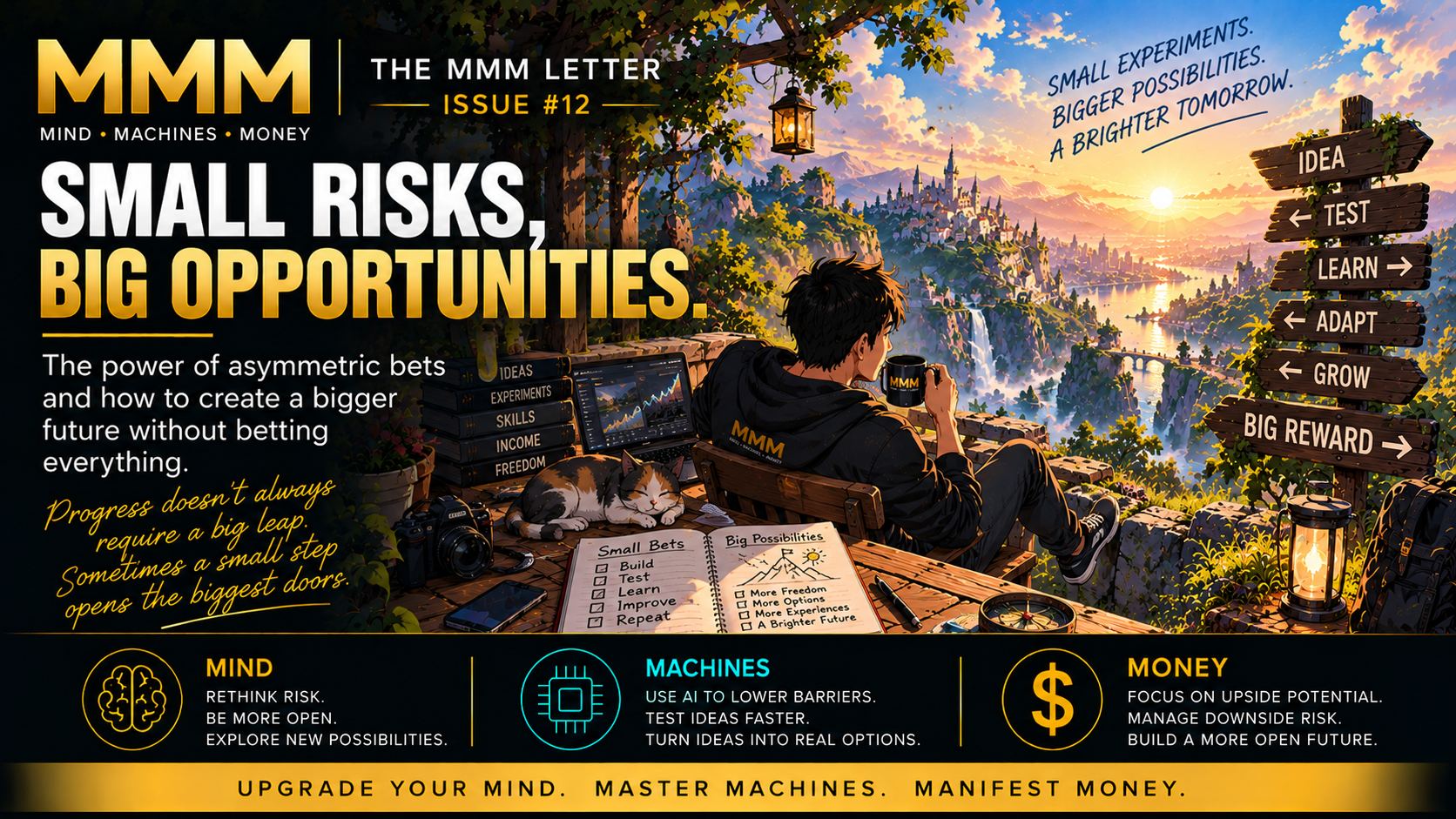
Most people assume that achieving something significant requires taking significant risks.
If you want to build wealth, you need to invest a lot of money. If you want to start a business, you need to quit your job and go all in. If you want to change your life, you need to make some dramatic decision that puts everything on the line.
It’s an appealing story, especially because we hear it so often from successful entrepreneurs and investors.
The problem is that we tend to hear from the people whose big risks paid off. We rarely hear about the thousands of others who made similar decisions and lost everything.
There’s another approach that doesn’t get nearly as much attention.
Instead of taking enormous risks in pursuit of enormous rewards, look for opportunities where the potential upside is much greater than the downside.
These are known as asymmetric bets.
The idea is simple. You put something relatively small at risk for a chance at a much larger reward.
You might spend a weekend testing a business idea that eventually becomes a source of income. You could invest a few hours learning a skill that opens up new career opportunities. You might publish an article that costs almost nothing to produce but continues attracting readers for years.
Most of these attempts won’t lead to anything extraordinary. Some won’t work at all.
The interesting part is that you don’t necessarily need every attempt to succeed. If the cost of failure is small enough, you can afford to experiment, learn, and occasionally discover something worth pursuing further.
It’s a useful way to approach opportunities, especially when the future is uncertain.

Rethinking Our Relationship With Risk
People tend to think about risk in two ways.
Some avoid it whenever possible, preferring familiar situations even when they’re unhappy with the results. Others actively seek it out, believing that taking bigger chances will eventually lead to bigger rewards.
Neither approach tells the whole story.
What matters isn’t simply how much risk you’re taking. It’s what you’re risking compared with what you might gain.
Consider someone who wants to become a writer.
They could quit their job, spend their savings, and devote an entire year to writing a book. If the book doesn’t sell, the financial consequences could be serious.
Alternatively, they could begin publishing articles online during their free time.
The second approach offers a way to test whether they enjoy writing, whether people respond to their work, and whether there’s an audience worth building.
If it doesn’t work, they’ve lost some time but gained experience. If it does work, they can gradually invest more resources into it.
The goal is the same, but the risk is very different.
This doesn’t mean every worthwhile opportunity can be tested cheaply. Some careers, businesses, and personal goals require substantial commitments.
Still, it’s worth asking whether there’s a smaller version of the decision you can make first.
Can you learn something useful without putting everything on the line?
That question can open up opportunities you might otherwise avoid.
There’s also a psychological benefit. When failure isn’t financially or emotionally devastating, it becomes easier to try unfamiliar things.
You don’t need to convince yourself that success is guaranteed. You only need to decide whether the experiment is worth its cost.

AI Is Making Small Experiments More Accessible
One of the more interesting effects of AI is how much it has reduced the cost of trying new ideas.
Not long ago, building even a basic software product often required hiring a developer or spending months learning to code.
Creating professional-looking marketing materials could require a designer. Researching an unfamiliar industry might involve days of searching through websites and reports.
Many of these tasks are now easier and cheaper to attempt.
Someone with a business idea can use AI to research potential customers, develop a basic prototype, create marketing materials, and test whether there’s any interest before making a larger investment.
That doesn’t mean AI can build a successful business for you. A working prototype isn’t the same as a product people want, and AI-generated research still needs to be checked against reliable information.
What has changed is the cost of getting started.
Imagine you’ve been thinking about creating a small software tool.
Previously, you might have dismissed the idea because you didn’t have the technical skills or money to hire someone.
Today, AI coding tools may help you create a simple working version. It might not be polished, and you may still need technical help, especially if the software handles sensitive information or payments.
Even so, you could potentially learn whether the idea is worth pursuing before spending thousands of dollars.
That’s a meaningful change.
AI doesn’t eliminate business risk, but it can make certain experiments much less expensive.
The opportunity isn’t to launch dozens of random projects simply because technology makes it possible.
It’s to use these tools to test promising ideas before committing significant resources.

You Don’t Need to Bet Everything to Build Wealth
The concept of asymmetric bets also appears in investing, although it requires some caution.
Imagine two opportunities.
The first offers the possibility of doubling your money, but there’s also a meaningful chance of losing your entire investment.
The second offers a smaller potential return but carries much less risk.
Which one is better?
There’s no answer without knowing more about the probabilities, the size of the potential losses, and how much money you’re putting at risk.
A large potential payoff doesn’t automatically make something a good investment.
This is where people sometimes misunderstand asymmetric opportunities.
They see a cryptocurrency that could increase tenfold or a speculative stock that might double and assume they’ve found an attractive bet.
What they overlook is the possibility that the asset could lose most or all of its value.
An opportunity becomes more interesting when the potential reward is attractive relative to both the probability and size of the loss.
Even then, position sizing matters.
Someone who puts their entire savings into a speculative investment may have identified a promising opportunity, but they’ve also created a situation where being wrong could cause serious financial damage.
A smaller position can allow someone to participate in a speculative opportunity without making their financial future depend on it.
For most people, a diversified long-term investment strategy remains a more dependable foundation than constantly searching for extraordinary returns.
Asymmetric opportunities can also exist outside financial markets.
A small business might require limited startup capital but have room to grow. A digital product could be created once and sold repeatedly. Learning a valuable skill could increase your earning potential for years.
These opportunities still involve costs, competition, and uncertainty.
The advantage is that you may be able to control how much you risk while leaving room for a meaningful payoff.
Action Steps You Can Take Today
Think about something you’ve wanted to pursue but haven’t started because it seems too expensive, difficult, or risky.
Maybe it’s starting a business, learning a new skill, changing careers, or creating something of your own.
Now consider whether there’s a smaller experiment you could run.
If you’re interested in starting a business, could you test the idea with a simple landing page before building the product?
If you’re considering a career change, could you take an introductory course or complete a small project before committing to a degree?
If you want to create content, could you publish consistently for a few months before investing in expensive equipment?
The purpose isn’t to eliminate every possible risk. That’s rarely realistic.
Instead, try answering three questions:
- What’s the most I could realistically lose? Consider your time, money, and any other meaningful consequences.
- What could I gain if it works? Look beyond immediate financial rewards to skills, relationships, experience, and future opportunities.
- Can I test this on a smaller scale? Look for ways to learn before making a larger commitment.
Not every experiment will succeed, and not every opportunity will turn out to be worth pursuing.
That’s part of the process.
Over time, though, you may discover that some of the most valuable opportunities in life don’t require enormous sacrifices upfront.
They require curiosity, a willingness to experiment, and enough judgment to recognize when something deserves a larger commitment.
Sometimes the smartest way to pursue a big opportunity is to start with a small bet.
Thanks for reading. We’ll see you next Friday.
— Phil Zen Kim
Founder & Editor-in-Chief, MMM
P.S. Think about an idea you’ve been putting off because you aren’t sure it will work. Is there a way to test it this week without making a major commitment?